For more than five decades, Trent Angers has dedicated his life to journalism, publishing, and preserving the stories that define Louisiana and its people. As founder, editor, and publisher of Acadian House Publishing, Trent has edited and published 126 books over a 45-year career while also authoring six books of his own. His work has ranged from Cajun history and Louisiana political figures to military ethics, faith, and inspirational storytelling.
A graduate of LSU’s School of Journalism, where he was named Outstanding Graduating Senior and received the Hodding Carter Award for Responsible Journalism, Trent followed in the footsteps of his father, Bob Angers, founder of Acadiana Profile magazine. Trent would eventually spend 36 years as editor and publisher of Acadiana Profile, helping build it into one of the longest-running regional magazines in America before selling the publication in 2010 to focus full-time on book publishing with Acadian House Publishing.
During our conversation, Trent reflects on a life immersed in words, ideas, and the people behind them.
“Born with printer’s ink in my blood”
Trent jokes that journalism was his destiny. “You could say I was born with printer’s ink in the blood.”
His father purchased the Franklin Banner-Tribune in 1953, and Trent grew up watching the realities of community journalism firsthand. When Bob Angers launched Acadiana Profile in 1968, regional magazines were virtually unheard of.
“I thought he had lost his mind because there was almost no such thing as a city or regional magazine in this country at the time.”
Instead, Bob Angers proved to be a visionary. More than fifty years later, the publication remains an important voice for South Louisiana.
Acadian House Publishing: More Than Books
Today, Acadian House Publishing is one of Louisiana’s most respected independent publishers. Its catalog includes biographies, history, cookbooks, inspirational works, faith-based books, and regional classics.
Trent describes publishing as far more than simply printing books.
“Publishing involves careful acquisition of titles, careful editing, fact-checking, correcting, perfecting, marketing, warehousing, accounting, and distribution.”
Acadian House receives approximately 150 manuscript proposals each year but publishes only three or four books annually.
“No is the most powerful word in the English language.”
With limited capacity, Trent looks for books that move people, educate readers, and inspire meaningful reflection.
Dispelling Myths About Cajun Culture
At age 40, Trent wrote his first book, The Truth About the Cajuns, a work designed to challenge stereotypes and misconceptions about Acadian people.
“The first book I actually wrote is when I turned 40. The book was titled The Truth About the Cajuns. The book was designed to dispel the myths and stereotypes about the Acadian people. We’re very proud of our Acadian heritage. We’re not simple minded people who aren’t so bright. We don’t all dwell in the swamp. Our lives do not revolve around eating, drinking and dancing
Trent wanted readers to understand that Cajun identity extends far beyond the caricatures often portrayed in popular culture.
The book remains one of the most thoughtful examinations of Cajun identity and heritage.
Dudley LeBlanc: The Original Champion of Cajun Pride
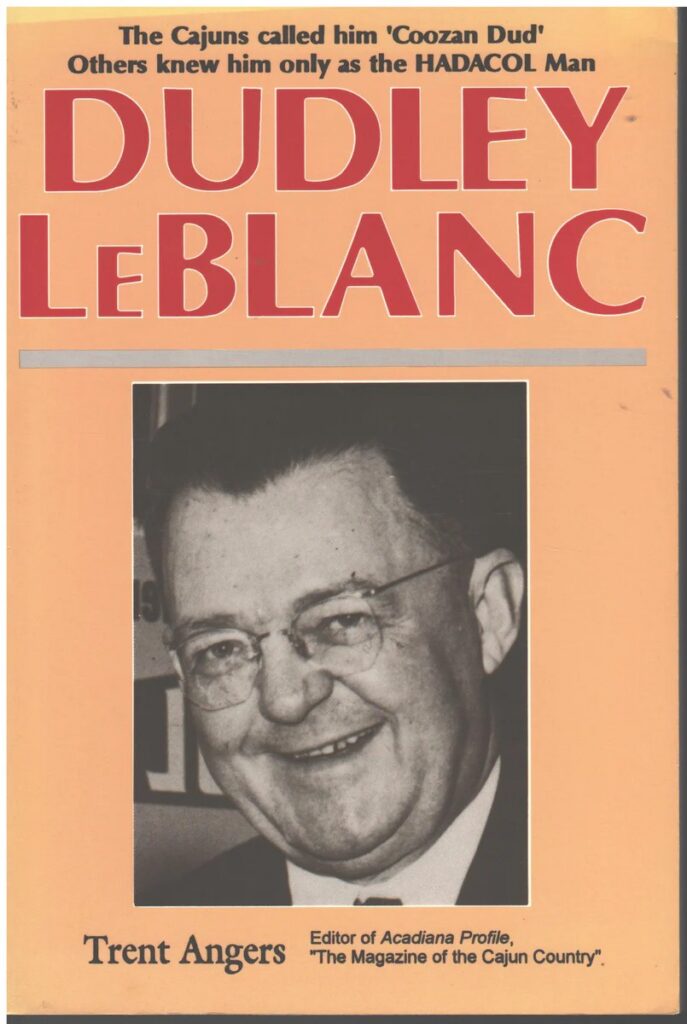
Another of Trent’s works is Dudley LeBlanc: A Biography, which chronicles the life of the legendary founder of Hadacol and one of Louisiana’s most colorful political figures.
“Dudley LeBlanc, who founded Hadacol, was also known as the political and almost spiritual leader of the Acadian people. He had a French language radio show emanating from from Abbeville. The truth is, Dudley started the French Renaissance movement before Jimmy Domengeaux formalized it through CODIFIL. Dudley LeBlanc would bring it up and say, ‘Let’s stand up for our Acadian heritage and be proud and not ashamed of who we are, not ashamed of our heritage and culture.”
While many remember LeBlanc for his wildly successful patent medicine business, Trent argues that his greatest contribution was cultural. Long before organizations formalized the movement to preserve Cajun culture, LeBlanc encouraged Acadians to embrace their language, traditions, and identity.
According to Trent, both Dudley LeBlanc and James Domengeaux deserve tremendous credit for preserving and advancing Acadian culture in Louisiana.
The Forgotten Hero of the My Lai Massacre
Perhaps no project has shaped Trent’s career more than The Forgotten Hero of My Lai: The Hugh Thompson Story.
The book tells the story of Hugh Thompson Jr., the American helicopter pilot credited with stopping the My Lai Massacre during the Vietnam War. “I became Thompson’s biographer and spent lots and lots of time with him in Vietnam, in Norway, and throughout the United States, in Washington, D.C., etc. I wrote his speech when he received the soldier’s medal in Washington at the Vietnam Wall, which is the highest award a soldier can earn for anything other than direct combat with the enemy,” Trent said.
Trent devoted more than 3,000 hours of research across three continents to tell Thompson’s story. “That book was my opus.”
The defining moment came when Thompson landed his helicopter between fleeing Vietnamese civilians and advancing American soldiers. “Not on my watch,” he said.
Thompson ordered his gunner to protect the civilians, even if it meant turning their weapons on fellow Americans. His actions saved lives and ultimately helped bring the massacre to an end.
Trent explains why Thompson’s story continues to resonate: “They were willing to give up their lives just because it was the right thing to do.” The book has since been placed on the reading list of the Joint Chiefs of Staff because of its lessons on leadership, battlefield ethics, and moral courage.
Publishing Louisiana’s Most Influential Voices
Over the years, Acadian House has published works by an extraordinary range of Louisiana authors and leaders.
Among them are books by:
Dale Brown
Lt. General Russel L. Honoré
Marcelle Bienvenu
Camille Pavy Claiborne
Brian Sibley
Chad Judice
Trent speaks admiringly of each, emphasizing not only their accomplishments but also their character, intellect, and ability to inspire others.
Dale Brown and Human Dignity
One of Trent’s most meaningful publishing relationships has been with legendary LSU basketball coach Dale Brown.
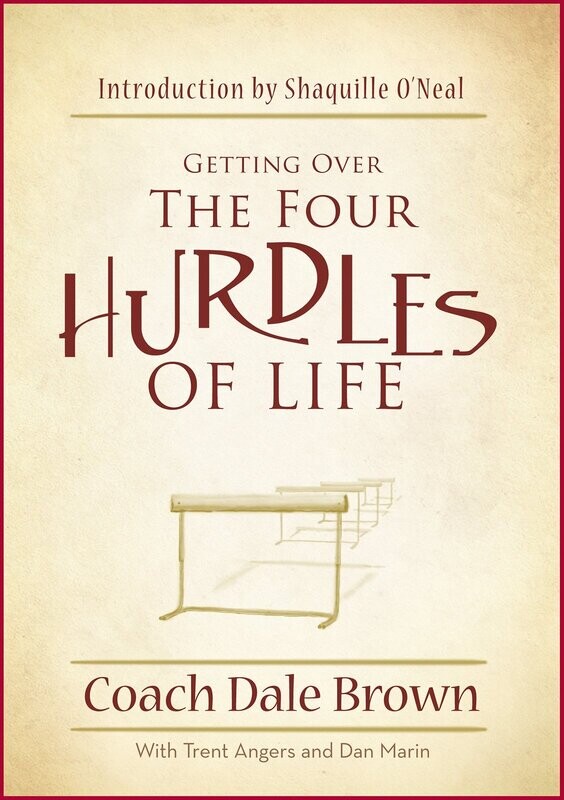
Acadian House published Brown’s Getting Over the Four Hurdles of Life, and Trent later authored Dale Brown: Caught in the Battle for Human Dignity.
He also played a significant role, along with Lafayette attorney Glenn Armentor, in the effort to have LSU’s basketball court named in Brown’s honor.
“Every generation needs role models.”
For Trent, Brown represents integrity, courage, compassion, and leadership. “Dale Brown is a role model of integrity, courage, bravery, intelligence.”
Those qualities made him not only a successful coach but also one of America’s most sought-after motivational speakers.
The Secret Life of an Editor
One of the most fascinating parts of our conversation centered on the editor-author relationship.
After working closely with writers for months or years, Trent says editors often develop a deep understanding of how authors think.
“We call that mind meld.”
His philosophy is simple: “The job of an editor is to make the writer look like a genius.”
That requires more than correcting grammar. It involves improving structure, strengthening logic, checking facts, and helping authors communicate their ideas as clearly as possible.
Cookbooks Outsell Almost Everything
Despite publishing biographies, history, and inspirational works, Trent admits one category consistently surprises him: Cookbooks.
Acadian House’s most successful title is Marcelle Bienvenu’s iconic cookbook Who’s Your Mama, Are You Catholic, and Can You Make a Roux? The book has sold approximately 200,000 copies.
“That book is in the top one percentile of books ever published in America.”
For Trent, the success is both gratifying and humbling. “You do a cookbook and you sell the heck out of it.”
The enduring popularity of Louisiana food culture continues to introduce readers around the world to Acadiana traditions.
Freedom of the Press
As a lifelong journalist, Trent remains deeply passionate about the First Amendment. “Freedom of the press is the hill I would die on. This country is free, in part because of the free press. Because of the free flow of information. It’s the press’s job to educate, to inform, to entertain. We serve the public, not the government. The press exists to serve the public.”
He argues that a free society depends upon the free flow of information and a press willing to challenge power when necessary.
“The press exists to serve the public, not the government.”
Regardless of political affiliation, Trent believes journalism’s highest calling remains informing citizens and protecting democratic accountability.
What’s Next: Orphan Train to Louisiana
Among Acadian House’s upcoming projects is Orphan Train to Louisiana, a book examining the little-known story of thousands of orphaned children transported from New York City to families across America.
The project was inspired by a staggering historical reality.
“At one point in New York City there were 30,000 babies and children on the street, homeless.”
The book explores the efforts of religious organizations and charitable groups that worked to place children with loving families, including many in Louisiana.
For Trent, it is exactly the kind of story Acadian House loves to tell: forgotten history that reveals the best of humanity.
Faith, Service, and Gratitude
Outside of publishing, Trent is active in the Secular Franciscan Order, whose members seek to live according to the spirit of Saint Francis of Assisi through service, humility, and care for others.
Reflecting on his blessings, he says: “We’re among the luckiest people in the world, in the history of civilization.”
That perspective of gratitude, combined with a lifelong commitment to storytelling, continues to shape his work today.
Whether preserving Cajun history, documenting battlefield courage, promoting faith-filled voices, or introducing readers to remarkable Louisianans, Trent Angers remains one of Acadiana’s most important cultural storytellers.
To learn more about Trent Angers and Acadian House Publishing, visit their website and explore a catalog that reflects the rich history, culture, faith, and character of Louisiana.